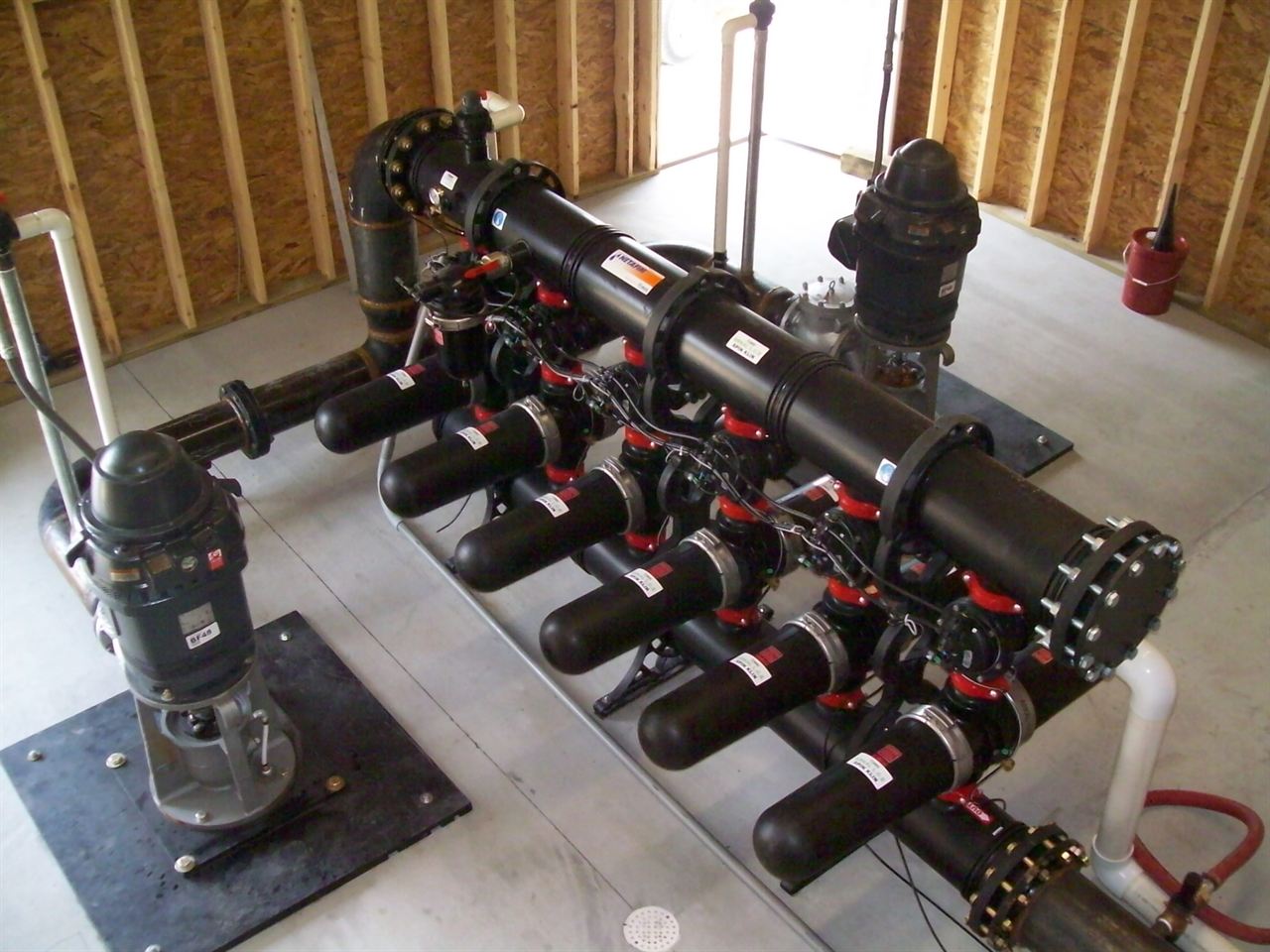
Screen, disc, media and automatic self-cleaning filters sized to flow rate and water quality.
Every drip emitter, spray stake and mister on a production nursery has an orifice small enough to plug, and the filter at the head of the system is what stands between your water supply and a block that waters unevenly. This page covers screen, disc and media filters, from a manual unit on a greenhouse head to automatic self-cleaning stations on a mainline, plus sand separators and flush controllers.
The decision that matters most is not the brand. It is what is in your water. Well water carrying sand, pond water carrying algae and clean municipal supply each call for a different filter type, and choosing by pipe diameter instead of water quality is where most filtration trouble starts.
Screen, disc or media: which type does your water source call for?
Start from the source, not the catalog. Three cases cover nearly every nursery and greenhouse.
Clean well or municipal water with little suspended solid is screen territory. A manual screen filter such as the Amiad Manual Plastic Amiad Series, Toro F100 Series Filters or Rivulis F6150 Screen Filter protects a greenhouse head or a small block. Whatever sits at the station, a Hunter HY Series filter belongs in front of every drip and micro zone.
Well water carrying sand or grit needs a centrifugal separator ahead of the filter. The Amiad Sand Separator Series and Rivulis F1300 Hydrocyclone Filter spin grit out before the screen sees it and stop the constant backflushing.
Pond, canal, recycled or other surface water carries algae and organic matter that lies across a screen and blinds it. Disc filters are the first step up: grooved discs filter in depth rather than straining at the surface, so the Amiad Manual Plastic Arkal Series and Spin Klin, Netafim AlphaDisc Disc Filter and Rivulis F7050 Disc Filter hold organic load a screen of the same rating would blind on. For heavy algae, go to media: the Amiad Media Series, Netafim SandStorm Media Filters, Toro Aqua-Clear and SentrySand Sand Media Filters, Rivulis F2300 Media Filter and Irritec Metal Sand Media Filters put a bed of media in the path, which pond and canal supply usually needs. Where the water also carries weed and debris, an Amiad ABF Series coarse screen protects the fine stage.
What micron rating, flow and pressure does the filter need to match?
Micron rating is set by the smallest orifice downstream, not by what the filter can do. Specify to the emitter maker's published requirement. Most drip and micro zones land near the 150-mesh screens on the Hunter HY Series Filters and HFR Filter Regulators. Amiad's Manual Plastic Amiad Series runs 50 to 3,500 micron, the Manual Plastic Arkal Series reaches 20 and the TAF Series 10, but finer than the emitter needs only loads the element faster.
Flow sets the body size. Rate it to what the zone or mainline actually draws, with headroom; a filter run near capacity loads fast and pressure drop climbs. For scale: Hunter HY Series up to 20 gpm at a zone head, Amiad Spin Klin Compact Angle 2" up to 66 gpm for one greenhouse, TAF Series up to 220 gpm for a greenhouse head, Sigma Pro Series up to 1,233 gpm on a nursery mainline.
Pressure has a window at both ends. The Hunter HY Series is rated 20 to 120 psi and the Toro Aqua-Clear Sand Media Filters to 75 psi, so check against pump output. Every filter costs pressure, and the loss grows as it loads, so fit gauges both sides and flush on differential, not calendar. Automatic units also need pressure and flow to backflush. The Netafim 2" Compact LP Disc-Kleen is built for low-pressure spray stake and drip blocks, and the Hunter HFR Filter Regulators pair a 150-mesh screen with regulation to 25 or 40 psi in one preassembled fitting.
The mistakes we see, and how the manufacturers' lines differ
The failures we see are rarely a filter that broke. Usually it was chosen for the wrong water or never cleaned.
- A screen on pond water. It blinds, somebody cleans it, then nobody does. Disc or media is the fix; if a screen stays, an Amiad Brushaway Series, Scanaway Series or Rivulis F6400 Semi-Automatic Screen Filter cleans with a handle, the difference between a filter that gets serviced and one that does not.
- Sized to the pipe, not the flow. Matching the mainline diameter but not the flow rate leaves it undersized the day the whole nursery runs at once.
- An automatic filter with no controller. The Amiad ADI-P Controller and Netafim Backflush Controllers are what make a self-cleaning filter self-cleaning. Where supply cannot drop mid-flush, Amiad Spin Klin Batteries, Netafim SandStorm Double Chamber or Rivulis F3440 Continuous Circulation Screen Filter keeps filtering through it.
Amiad is a filtration specialist with a deep range, manual through automatic, disc, media and sand separators; if water quality is your constraint, size from there. Netafim and Rivulis sell filtration as part of a full head end; Rivulis also offers a hydraulic automatic screen needing no power. Toro's Aqua-Clear media tanks are fiberglass, so corrosion is not the failure mode; its F100 Series takes a screen or disc element. Hunter, Rain Bird and Antelco cover the zone end; Irritec build their own screen, disc and media units. Request a quote with your water source, flow and emitters and ask us about sizing.
Frequently asked
Do I still need a zone filter if there is an automatic filter at the pump?
Yes. The station filter protects the mainline, but grit and pipe shavings get into the system downstream of it whenever a line is cut, a valve is changed or a lateral is repaired. A small inline filter at each drip or micro zone head, such as the Hunter HY Series with its 150-mesh stainless screen, is the last defense before the emitters and is standard practice on nursery systems.
Screen or disc for a nursery running on pond water?
Disc, and media if the algae load is heavy. A screen strains at the surface, so organic matter lies across it and blinds it. Disc filters use stacked grooved discs that filter in depth, which holds organic material a screen of the same micron rating would pass or blind on. Where a screen spends the day backflushing, a sand media tank is the usual answer for pond and canal supply.
How do I know what micron rating to specify?
The smallest orifice downstream sets it. Every dripper, spray stake and mister maker publishes a filtration requirement in mesh or micron; specify the filter to the finest one on the system. Going finer than that loads the element faster without protecting anything. If you are unsure, tell us the emitters you are running when you request a quote and ask us to check the filtration rating and flow capacity against them.
Who does ML Irrigation sell filtration to?
ML Irrigation is a wholesale supplier to production nurseries and greenhouse operations, and filtration is specified the same way as the rest of a system: from the water source, the flow rate and the emitters downstream. If you are specifying filtration for a new block or replacing a station that is not keeping up, send us those three details and request a quote, and we can work through the options with you. We ship to growers in all 50 states from Fountain Inn, South Carolina, and also supply horticulture education and research programs.
When is an automatic self-cleaning filter worth it over a manual one?
When the water is dirty enough that cleaning falls behind, or the station is far enough from the barn that nobody walks out to it. Semi-automatic units with a cleaning handle sit between the two. An automatic filter needs a flush controller to sequence its backflush, and where there is no power at a remote pump, Rivulis offers a hydraulically driven automatic screen filter.